Minecraft Education Edition in Science – Background
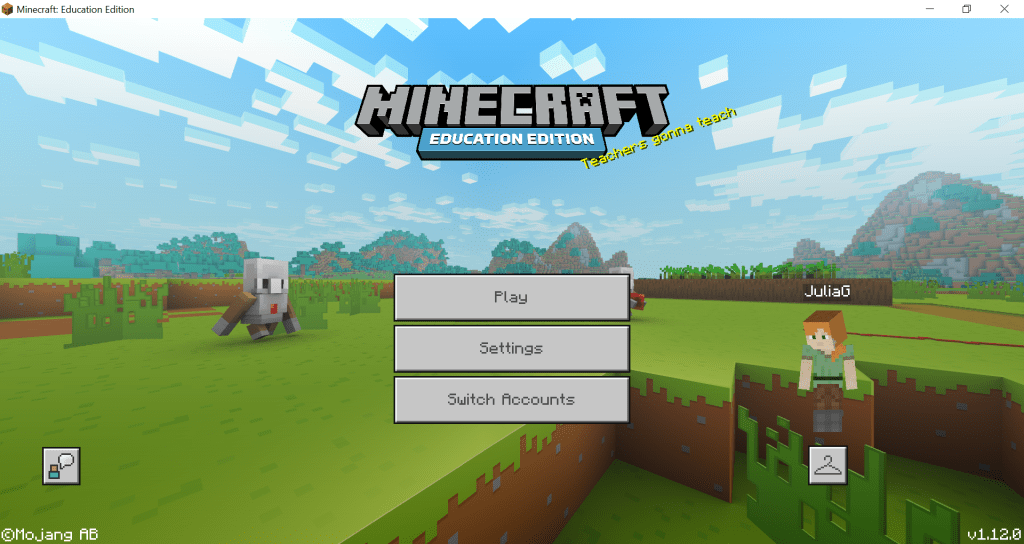
Minecraft Education Edition is an online platform that has been designed to enable teachers and students to create and explore a virtual reality. The operations are similar to the mainstream game of Minecraft game except that teachers are given additional controls over their classes, specialty blocks, chat tools and tutorials of how to use Minecraft Education Edition. Teachers and students are usually required to log on through their school platform which means that students are within a virtual reality which contains only other students and their teacher.
This platform contains:
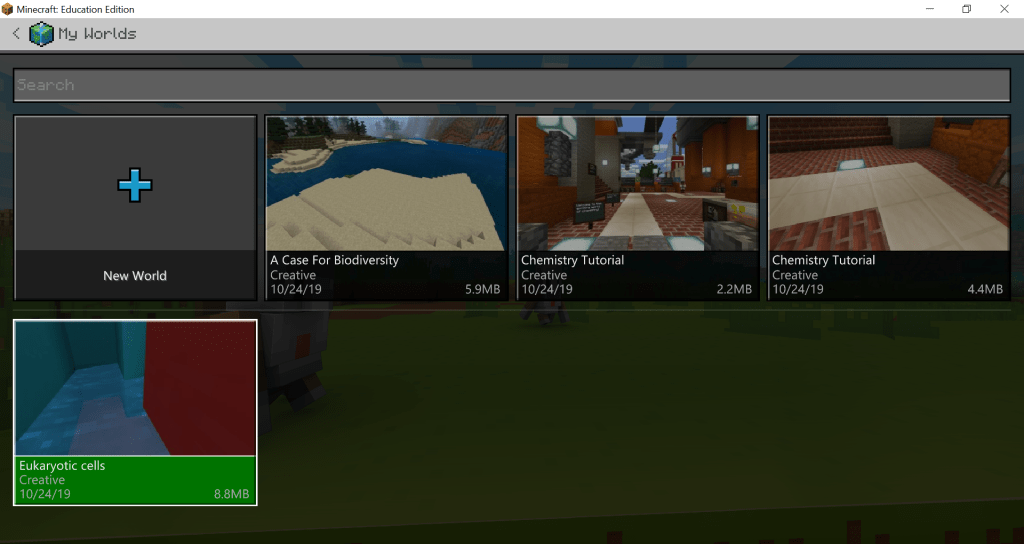
- “View My Worlds” which is a database of worlds that have already been created and explored.

- “Create New” which allows the user to make customised worlds through “create new” or to import worlds created by others (see Figure 2)

- “Join World” which allows the user to join worlds of those that are already active. This would be used in the case of a teacher asking students to join a world for their lesson. (See Figure 3)

- “View My Worlds” which allows the user to see the worlds that they have previously explored.
2019, from https://education.minecraft.net/
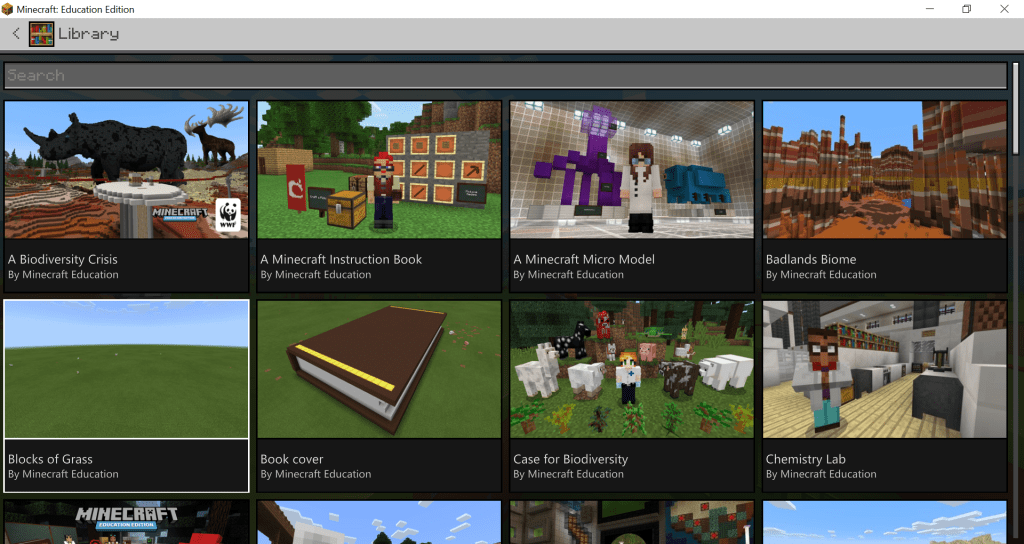
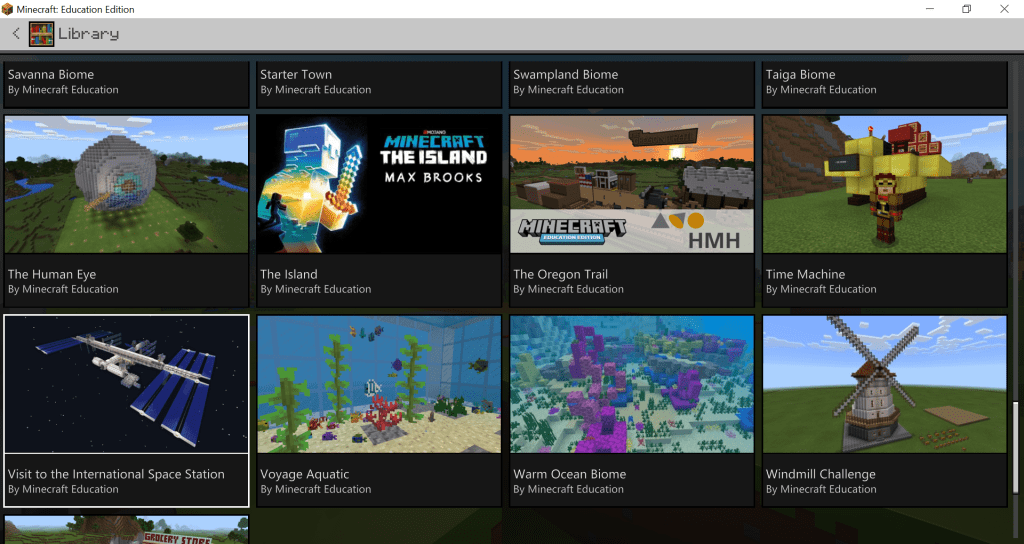
- “View Library” which allows the user to view worlds that have been generated by Minecraft Education for specific lessons plans. For Science the kinds of worlds that are available are worlds that explore (see Figures 6, 7 and 8):
- Biodiversity and Biomes
- Modelling in Science
- Chemistry Labs
- Vehicle Development
- Designing Spaces
- Visiting the International Space Station
- Circuit builder

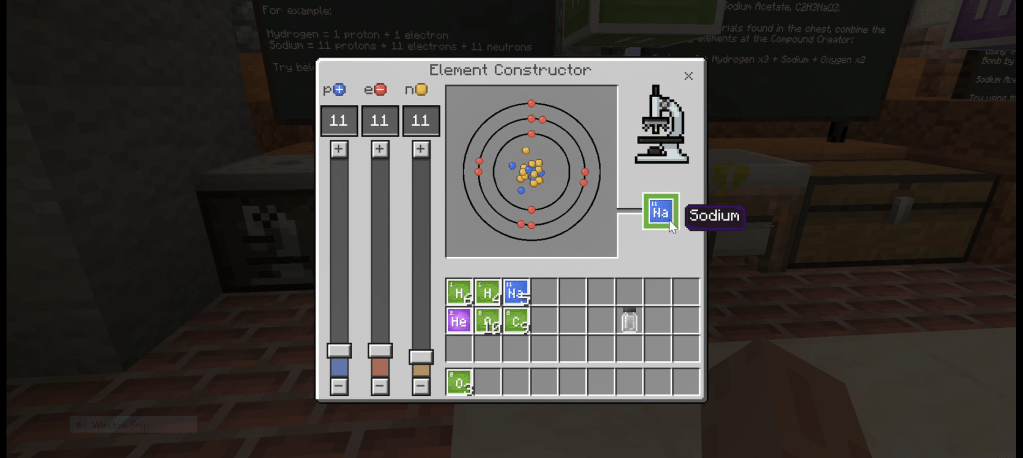
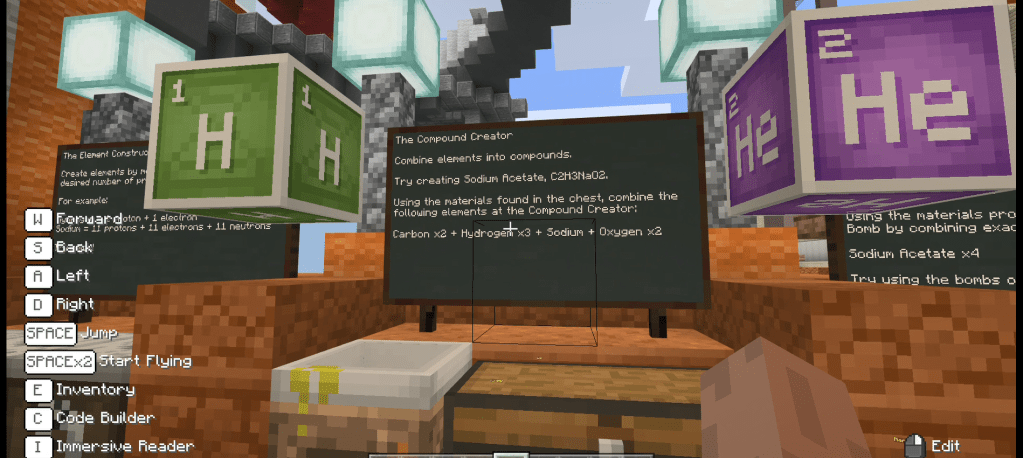
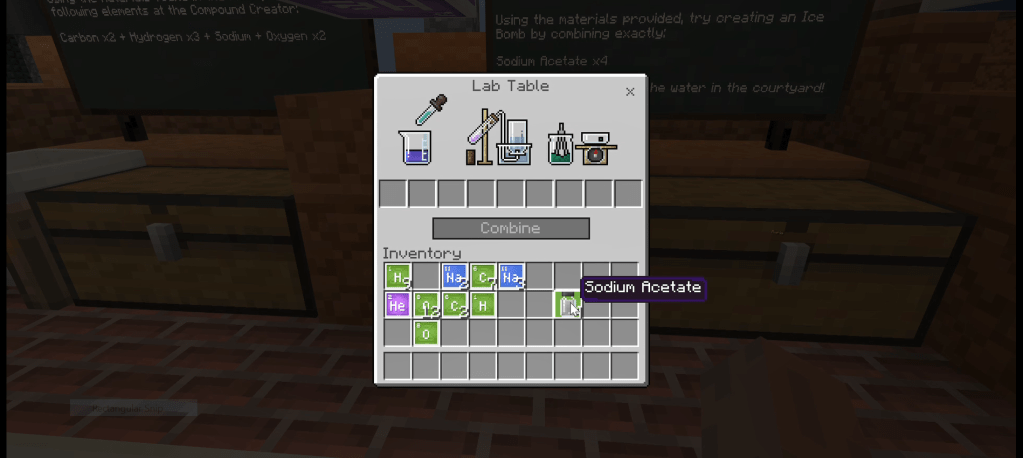
- While playing the game there could be open play construction, challenges created by the teacher or in pre loaded worlds such as a Chemistry Lab where they have to complete challenges such as making elements, combining these into compounds and completing further challenges with these compounds. (See Figure 9, 10 and 11)

Minecraft Education in Science Advantages
Nebel, Schneider and Rey (2016) expressed in their literature review of that the benefits of Minecraft in Education are the simplicity for students, the interactive and collaborative nature of the platform, and the function of transformational play (p. 359). In the Science context I see the main advantage of Minecraft Education is the ability for students and teachers to play and create realities that would not be possible in the real world. An example of this is recently my colleagues (Science Teachers) had their students (Stage 4) design their own zoo enclosures for an animal of interest. Students were able to create vet surgeries, education rooms, welcome areas, posters of their animals, viewing platforms and transport around the whole zoo. As they had unlimited space and resources, the limit was only their imagination and the basic rules within the Minecraft world. This relatively unlimited nature of this platform means that students are able to express themselves creativity and found the process highly engaging.
Minecraft Education in Science Limitations
The main drawbacks for a platform like Minecraft Education is that a great deal of time needs to be spent to ensure that genuine learning is occurring which might not be available to all schools. To ensure that the time spent in this platform leads to meaningful learning, there always needs to be tight parameters around the products, the time that they are able to spend on the game and specific criteria for success. Otherwise students might feel like they are aimlessly playing on the platform meaning solid learning may not be occurring. Further to this, there is a worry of addiction and perfectionism that can occur in a platform like Minecraft Education. There is always more to create, build and refine. Without strict guidance and time limits this could be an issue. Another drawback is that not all students enjoy using this platform so it would be important for teachers to use this tool as one of the many tools that they use to engage students to ensure there is enough differentiation and variety. This should not be the only way students can engage and communicate their learning as building a physical model and manipulating real equipment in a Science lab is of great importance to ensure students know how to operate experiments in the real world. Furthermore, as the Minecraft world oversimplifies physical and environmental rules of the real world, the models created will have limitations of accuracy and thus fidelity of the platform to real life. (Bower, 2017, p. 331) For example, Minecraft has no curves and the light in the game is not accurate to the way light would actually move and reflect off a structure which is a draw back for in. (Nebel, Schneider and Rey, 2016, p. 360)
References:
Bower, M. (2017). Design of technology-enhanced learning – Integrating research and practice. Bingley, UK: Emerald Publishing Group
Minecraft: Education Edition. (2019). Retrieved 24 October 2019, from https://education.minecraft.net/
Nebel, S., Schneider, S., & Rey, G. (2016). Mining Learning and Crafting Scientific Experiments: A Literature Review on the Use of Minecraft in Education and Research. Journal of Educational Technology & Society,19(2), 355-366.

 EDCN865 e-Porfolio - Julia Gale
Hi Julia
Thanks for your interesting post. I focused on Minecraft as an example as well but for teaching History so it was interesting to see how it can be used in other contexts. I very much appreciate your point about the need to ensure genuine learning is taking place. The example I looked at involved reconstructing world heritage sites but required initial research before building could begin. The ‘tight parameters’ you mentioned would apply here as well to make sure the research gets done. Craft (2016) suggests pre-preparing research materials and creating ‘how to’ videos which I think would really help but create more time demands.
I also appreciate your point about the oversimplification of the real world. I have a similar concern about work students do in relation to historical sights and the accuracy of representations. It was an area I could not find any research on – possibly something researchers will need to consider in the future.
Reference
Craft, J. (2016). Rebuilding an empire with Minecraft: Bringing the Classics into the Digital Space. Classical Journal 111(3), p 347-364.
LikeLike